

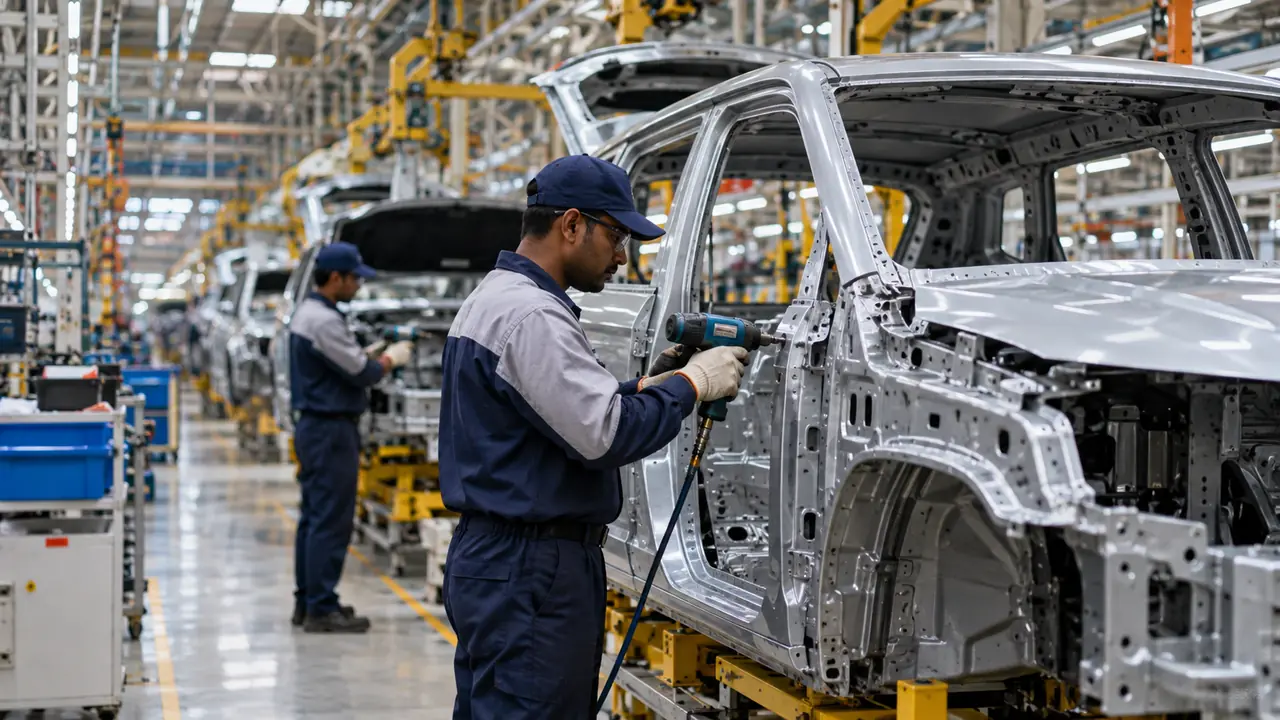
Hyundai Motor Group has committed to invest $15.5 billion in India between 2026 and 2032, placing manufacturing, research and local suppliers at the centre of its next phase of growth. The South Korean group unveiled the seven-year strategy on October 13, and Hyundai Motor followed it on October 14 by marking completion of its Pune automobile plant. Together, the announcements show both the size of a long-term investment plan and a specific expansion of production capacity.
The group programme covers new and expanded manufacturing facilities, research and development infrastructure, parts localisation and new vehicle technologies. Hyundai also intends to establish a dedicated investment entity in India to coordinate spending and financing. The total represents planned investment over seven years, not money already spent or a sum earmarked entirely for the Pune factory.
Executive Chair Euisun Chung discussed the programme with Indian Prime Minister Narendra Modi in New Delhi on October 13. Hyundai described India as a strategic market and a potential export base serving additional emerging markets. Its approach links vehicle manufacturing to engineering, suppliers and technology, rather than simply increasing the number of cars shipped from South Korea.
A Pune plant puts a long-term strategy into production
Hyundai Motor's manufacturing facility at Talegaon, near Pune in Maharashtra state, began operations on October 13 and held its completion ceremony on October 14, according to Yonhap. The plant initially has annual capacity for about 170,000 vehicles; Hyundai aims to increase that to 320,000 by 2030. The additional 150,000 units describe potential yearly production capacity, not confirmed sales or output.
Hyundai Motor India separately announced a phased investment of 110 billion rupees, or about $1.16 billion, in expanding Pune capacity through 2030, Reuters reported. This is a local-company investment announcement within the group's broader India strategy. It should not be mechanically added to the $15.5 billion group pledge, because Hyundai has not supplied a comprehensive allocation of the group commitment to specific projects.
Pune joins the Hyundai Motor India production network already operating around Chennai. At group level, Kia also manufactures cars in India. Hyundai's October 13 corporate announcement placed the group's combined Indian annual manufacturing capacity above 1.4 million vehicles when Hyundai and Kia facilities are counted together. That is a different measure from the annual capacity of Hyundai Motor India on its own.
Implications for South Korea
For Hyundai, expanding Indian factories and sourcing locally could reduce the need to rely on a single overseas production route while positioning the group closer to Indian buyers. The investment spans components, research and new technologies, meaning its impact could reach beyond vehicle assembly. Korean component makers that supply Hyundai may benefit from growing operations, while an increasing share of investment and production is also moving overseas.
India is already an important market for Hyundai, but additional capacity does not guarantee demand. The strategy's returns will depend on competitive pricing, models suited to local buyers, supplier availability, factory utilisation and performance against Indian and international rivals. The company has stated capacity targets, but actual production and sales will determine whether the planned expansion succeeds commercially.
Execution milestones
The order of events is significant: Hyundai announced the $15.5 billion India programme on October 13, and the Pune completion ceremony followed on October 14. They are related developments, not separate pledges for the same full amount. The factory gives investors and workers one observable measure of progress on a strategy otherwise scheduled to run through 2032.
The next milestones include the new investment entity, project-by-project spending disclosures, recruitment and supplier development, and Pune's progress toward annual capacity of 320,000 vehicles. The official commitment establishes the direction and scale. Its ultimate significance will be measured in completed projects, actual production and sustainable demand over the coming years.