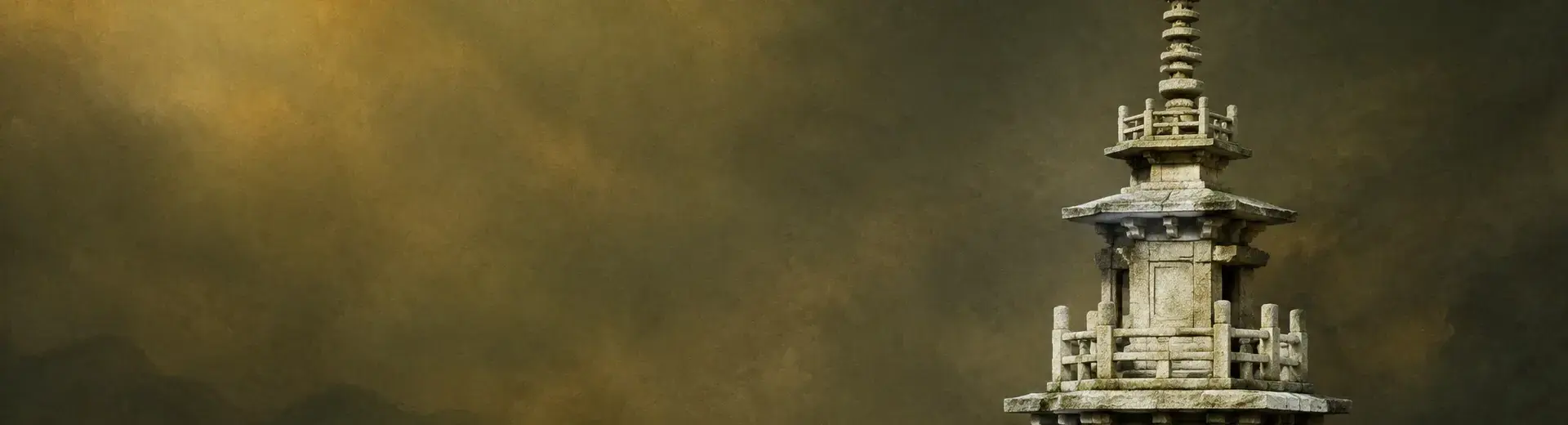


Changdeokgung Palace & Secret Garden
A UNESCO-listed Joseon palace where official halls, royal residences and the Secret Garden are fitted to the natural terrain of northern Seoul
Royal architecture, Joseon court history, landscape design, palace interiors and guided Secret Garden visits
A 58-hectare complex of gates, formal courts, residential compounds and a large wooded rear garden whose paths and buildings rise with the slopes
Seoul’s strongest demonstration that a royal palace could function as government, home and landscape at once, with centuries of court life still legible in the way the grounds unfold
Character
Changdeokgung is a palace shaped by terrain: halls, residential quarters and the wooded Huwon follow the folds of the foothills, giving royal government, household life and landscape a single, irregular setting
From Donhwamun, the route bends through gates, bridges and courtyards instead of presenting the whole complex at once. Injeongjeon provides the ceremonial center, but Changdeokgung’s identity becomes clearer as the route moves into royal offices, living quarters and Nakseonjae, then toward the wooded garden behind them. The palace feels accumulated rather than diagrammed: formal power, domestic life and retreat sit close together because the site grew with the land and with centuries of use
The experience
A first circuit works well through Donhwamun, Geumcheongyo Bridge and Injeongjeon before moving into the residential compounds. The scale changes repeatedly. Broad stone courts give way to tighter passages, painted timber buildings and quieter yards; Nakseonjae introduces a more restrained architectural language and brings the later royal household into the same walk
Huwon changes the rhythm again. Its ponds, pavilions, wooded slopes and long paths unfold as a landscape sequence rather than an extension of the palace courtyards. Buyongji and Juhamnu are among the best-known views, but the value of the garden is cumulative: architecture appears through trees, paths climb and turn, and the visitor experiences why Changdeokgung became famous for fitting palace life to existing topography. Garden access is timed, so a visit that includes Huwon should be planned around that fixed slot first
History
King Taejong founded Changdeokgung in 1405 as a secondary palace to Gyeongbokgung, and the rear garden began taking shape the following year. The complex burned during the Japanese invasion of 1592. Changdeokgung was rebuilt in 1610 before the other Seoul palaces and then served as the dynasty’s effective principal royal residence for roughly 270 years, until Gyeongbokgung was reconstructed in 1867
That long period of actual use matters. Successive reigns added spaces for government, study, ceremony and private life, including Ongnyucheon, Gyujanggak, Juhamnu, Aeryeonji and Yeongyeongdang. Under King Jeongjo, the library and pavilion around Buyongji tied scholarship and royal authority directly into the garden landscape. The later Nakseonjae area continued to house members of Korea’s last imperial family well into the twentieth century
UNESCO inscribed Changdeokgung in 1997, emphasizing the way official and residential buildings were integrated with the natural setting. That relationship remains the palace’s clearest historical argument: this was a working seat of rule whose architecture adapted to terrain over centuries instead of erasing it
Before you go
If the Secret Garden matters to your visit, secure that timed entry first and let the palace route flex around it. A palace-only visit can be paced freely through the main courts and residential areas, while Huwon creates a fixed appointment and a longer walking sequence. Anguk is the most direct subway approach. Inside the grounds, keep Nakseonjae and the garden side for the slower part of the visit; they make the palace’s shift from state ceremony to lived royal space much easier to read
- Hours
- Open Tuesday–Sunday from 09:00. Closing is 18:00 in February–May and September–October, 18:30 in June–August, and 17:30 in November–January; last entry is one hour earlier. Closed Mondays. Secret Garden visits use separate fixed session times
- Admission
- General palace admission is ₩3,000 for foreign visitors aged 19–64; 18 and under, 65+, and qualifying hanbok wearers enter the palace grounds free. The Secret Garden requires a separate ticket: ₩5,000 for ages 19+ and ₩2,500 for ages 7–18, plus a palace ticket. Children 6 and under enter Huwon free
- Access
- Plan Huwon first: Secret Garden entry is timed and capped at 100 visitors per language session, split between 50 online reservations and 50 on-site tickets. Palace buildings outside Huwon use general admission and can be visited around that fixed garden slot
- Transit
- For the simplest arrival, use Anguk Station on Line 3, Exit 3, about five minutes on foot. Jongno 3-ga Station Exit 7 is roughly ten minutes away and is useful when arriving on Lines 1 or 5