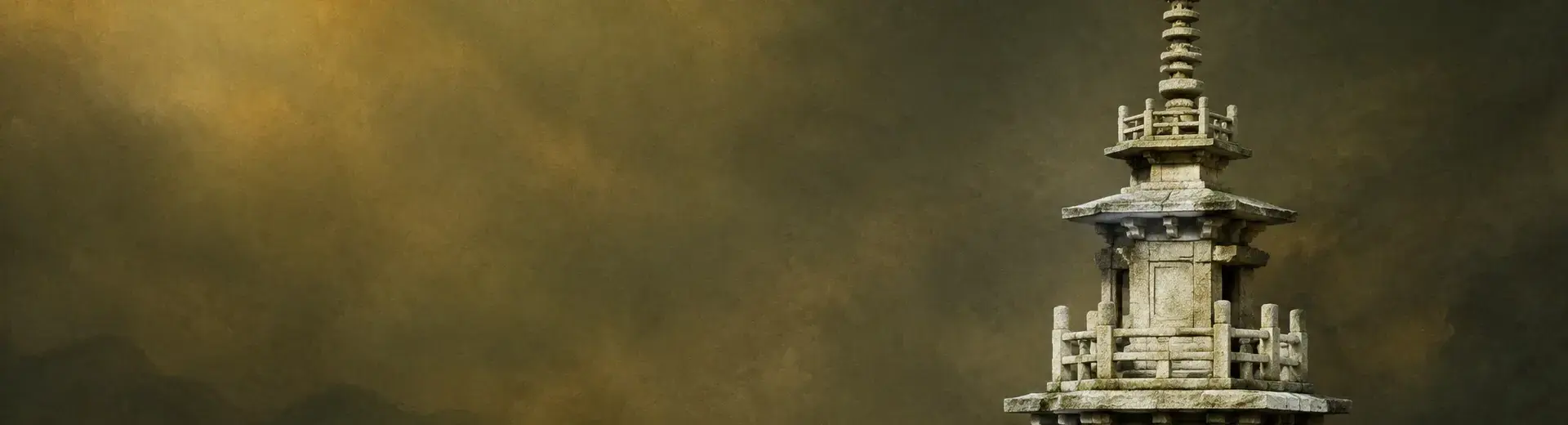


Gyeongbokgung Palace
Joseon’s principal royal palace, arranged as a ceremonial city of gates, courts, residences and gardens beneath Bugaksan
Court architecture, Joseon political history, palace gardens and a long walk through restored royal precincts
A large walled complex with a strong south–north ceremonial axis, side courts, residential quarters, ponds and several usable gates
Seoul’s clearest place to read royal power through space—and to see how modern Korea is rebuilding a landscape repeatedly destroyed and altered
Character
Gyeongbokgung turns government into geography: each gate, courtyard and raised hall moves the visitor deeper into the ceremonial order of the Joseon court, with Bugaksan closing the view to the north
The palace rewards attention to sequence. Gwanghwamun begins a formal south–north approach; successive thresholds lead toward Geunjeongjeon, where royal authority was staged in stone, timber and open court. Beyond it, the scale becomes more domestic and varied. Living quarters, libraries, gardens and pavilions reveal a royal compound that once operated as a working city rather than a single monumental building
The experience
The main axis gives a first visit its clearest structure. Enter at Gwanghwamun, continue through Heungnyemun and Geunjeongmun to Geunjeongjeon, then let the route loosen. Gyeonghoeru appears beside its pond as a place for state banquets; farther north, Hyangwonjeong and the residential precincts shift the mood toward water, trees and smaller enclosures
That change of scale is one of the palace’s strongest pleasures. Broad courts expose visitors to sun, wind and crowds, while side compounds slow the pace through narrower gates and quieter yards. The site is extensive enough that a fast circuit can collapse into a checklist. Two to three hours gives the architecture room to register; a shorter visit is best focused on the ceremonial axis and one garden area
Many buildings visible today are restored or reconstructed. Reading them as part of an active restoration landscape makes the visit richer: surviving nineteenth-century fabric, recreated structures and recovered spatial relationships sit together. The palace is therefore also a public argument about how a capital restores a damaged historic centre
History
Gyeongbokgung was founded in 1395, three years after the establishment of Joseon, as the dynasty’s principal palace in its new capital. Its placement joined political planning to the city’s mountain setting, while the sequence of gates and courts organised access to the king, government and royal household. The palace was also connected with major achievements of Sejong’s reign, including the creation and distribution of Hunminjeongeum
The complex burned during the Japanese invasions of 1592 and remained in ruins for roughly 270 years. King Gojong’s government rebuilt it in the 1860s, adding new compounds and restoring the palace as a centre of rule. In 1895, Empress Myeongseong was assassinated at Geoncheonggung, giving the northern precinct a particularly grave place in modern Korean history
Colonial rule brought another transformation. Large numbers of buildings were demolished, the grounds were used for exhibitions, and the Japanese Government-General building was placed across the palace’s central axis. Restoration began in earnest in 1990; the colonial government building was removed in the 1990s, and successive projects have rebuilt gates, courts and residential areas. The result remains unfinished by design: Gyeongbokgung continues to change as research and reconstruction recover parts of its former plan
Before you go
Decide whether this is a focused palace visit or part of a longer Jongno walk. For the palace’s intended spatial story, start at Gwanghwamun and follow the main axis north before exploring the side compounds. If you plan to continue toward Samcheong-dong or Bukchon, finishing near the eastern side avoids retracing the full route. The National Palace Museum and National Folk Museum are separate institutions with their own operating details, so treat them as additions rather than assuming they fit automatically into the palace visit
- Hours
- Open Wednesday–Monday from 09:00. Closing is seasonal: 17:00 in November–February, 18:00 in March–May and September–October, and 18:30 in June–August; last admission is one hour before closing. Closed Tuesdays
- Admission
- Foreign visitors aged 19–64 pay ₩3,000; visitors 18 and under and 65+ enter free. Visitors wearing qualifying hanbok also enter free. Korean nationals aged 25–64 pay ₩3,000, with different age-based exemptions
- Access
- Use Gwanghwamun for the full ceremonial approach. The palace grounds are extensive; the National Palace Museum and National Folk Museum are separate institutions with their own hours and entry arrangements
- Transit
- Choose the entrance before choosing the station. For the main Gwanghwamun approach, use Gyeongbokgung Station on Line 3; Gwanghwamun Station on Line 5 is also useful when arriving through the square. The eastern side works better when linking the visit with Samcheong-dong or Bukchon