

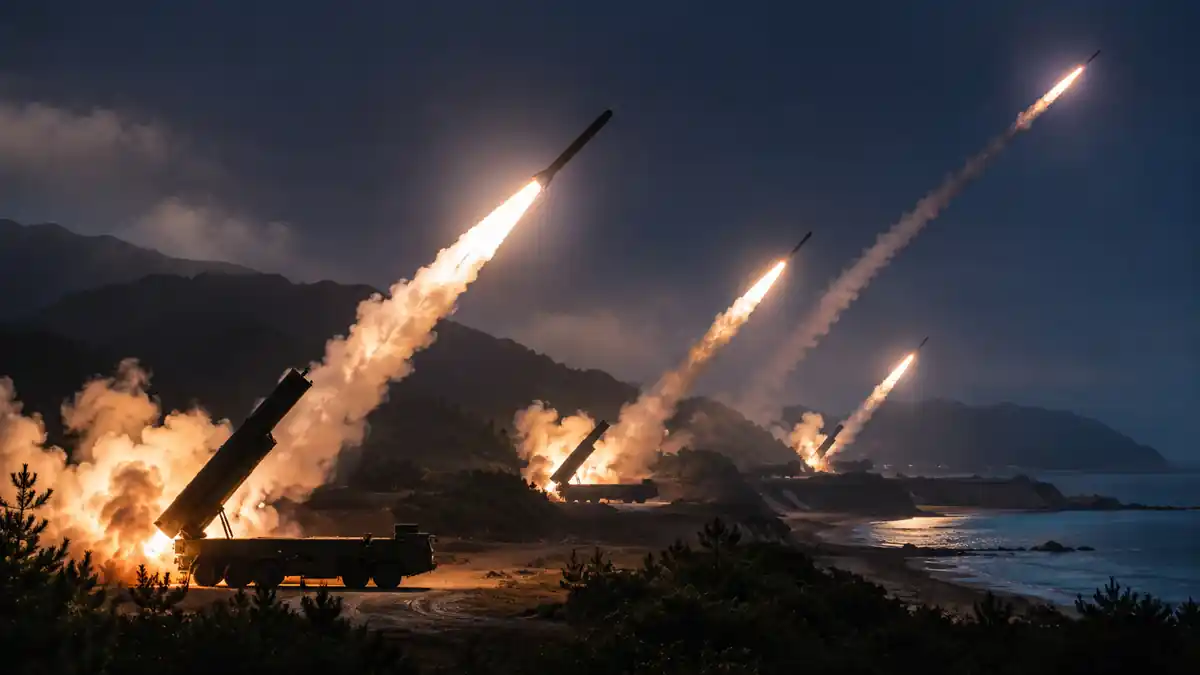
North Korea fired about ten short-range ballistic missiles from the Pyongyang area toward the East Sea on Thursday afternoon, according to South Korea's Joint Chiefs of Staff and multiple Korean reports. South Korean tracking put the flight distance at about 300 kilometers, while Japan said several missiles traveled roughly 320 kilometers and reached a maximum altitude of about 90 kilometers before falling outside its exclusive economic zone. The precise missile type was still under analysis.
The timing gave the launch unusual political weight. It came during the allies' shortened Ulchi Freedom Shield exercise, after U.S. President Donald Trump publicly renewed his interest in meeting Kim Jong Un, and after Kim Yo Jong rejected the idea that limited adjustments to allied military activity were enough to change Pyongyang's view of Washington. The launch also followed Chinese Foreign Minister Wang Yi's visit to Seoul, adding another layer of regional signaling.
Diplomacy and deterrence move together
The core tension is that diplomacy and deterrence are moving at the same time. Washington has tried to create room for renewed talks, while Seoul has emphasized that military readiness must continue. Pyongyang's barrage shows that it is not treating diplomatic overtures as a reason to pause weapons activity. That does not prove negotiations are impossible, but it raises the price of getting them started: any new channel would have to operate while both sides continue signaling strength.
For South Korea, the immediate military issue is whether the launch was primarily a weapons-development test or a saturation-style demonstration designed to show the ability to fire many tactical missiles in a short period. Korean authorities were considering several possibilities, including systems in the KN-25 class, but had not publicly settled the identification. That distinction matters because the political meaning of a large salvo can be different from a single experimental launch.
The episode also puts pressure on the sequencing of future U.S.-North Korea diplomacy. If Washington offers additional military or sanctions concessions before talks begin, critics can argue that Pyongyang is being rewarded while it continues launches. If the allies answer with a stronger military response, North Korea can use that response to justify further testing. Neither side therefore has an easy first move.
South Korea's response so far has emphasized monitoring and coordination rather than escalation. The military said it shared information with the United States and Japan and maintained readiness for additional launches. Seoul's National Security Office also convened an emergency meeting as officials assessed the launch and its implications.
What matters next is whether North Korean state media identifies the weapon and purpose of the barrage, whether launches continue after Ulchi Freedom Shield ends, and whether Washington keeps its diplomatic invitation open. A move toward working-level contact would be a meaningful change. Until then, the peninsula is entering a familiar but unstable pattern: military signaling is setting the conditions for diplomacy instead of disappearing before diplomacy begins.