

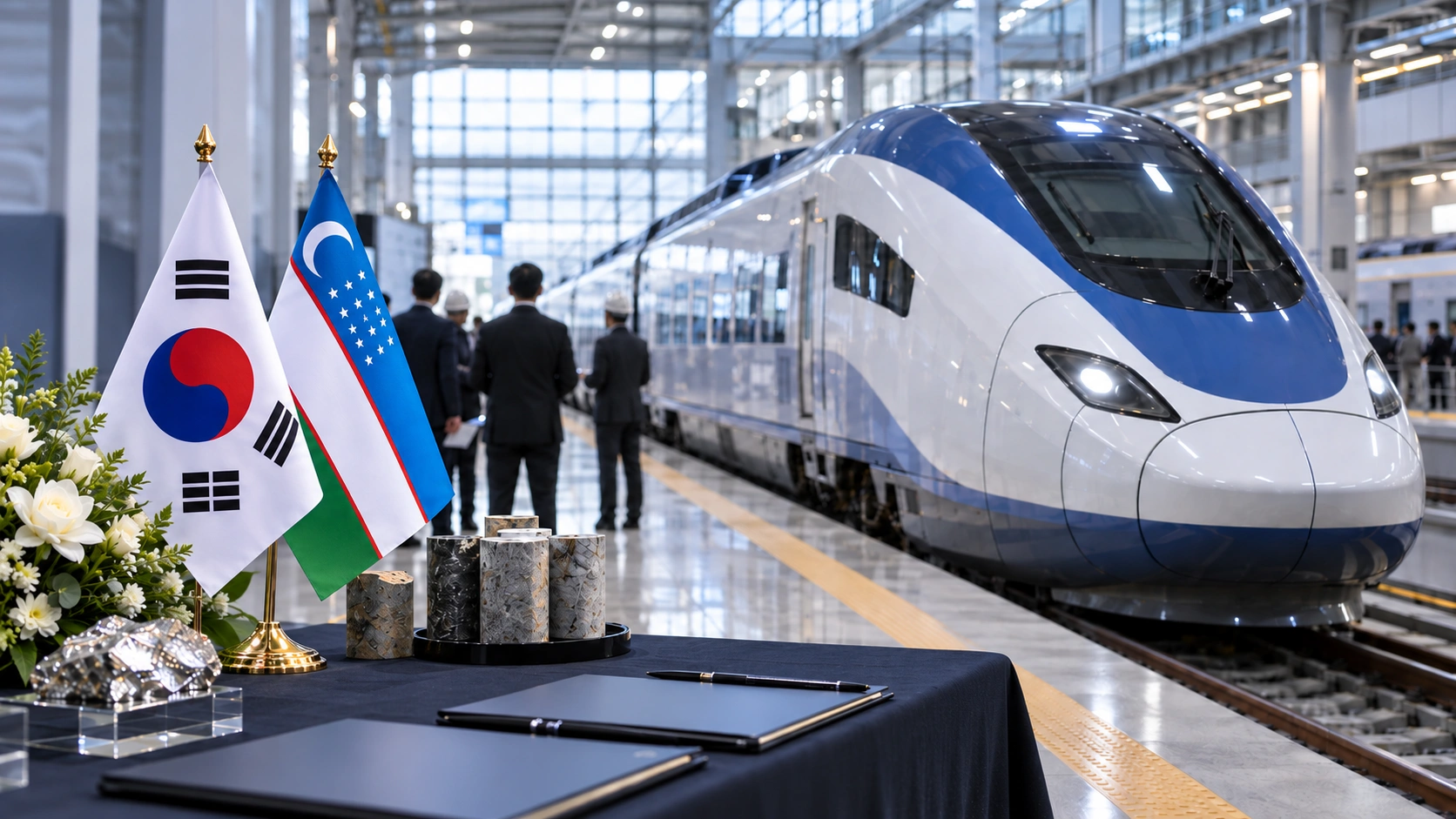
South Korea and Uzbekistan have widened a long-running infrastructure partnership into critical minerals, artificial intelligence and defense, giving President Lee Jae-myung's Central Asia diplomacy a more strategic economic focus. Lee met Uzbek President Shavkat Mirziyoyev in Seoul on September 14 during the Uzbek leader's state visit. Korean reporting says the two governments and related institutions signed 13 memorandums of understanding, while both presidents agreed to deepen cooperation in sectors that now sit closer to supply-chain security and advanced industry.
The relationship already has a concrete transport base. Uzbekistan is set to introduce eight Korean high-speed train sets, and the two sides have accumulated cooperation in rail, airports and logistics. The new agreements seek to build on that foundation rather than replace it. Critical minerals can link Uzbek resources with Korean manufacturing demand, while AI and defense open areas where technology transfer, industrial participation and government-to-government coordination may matter more than a single infrastructure contract.
From transport partnership to strategic industry
That shift is significant for Seoul because Central Asia is becoming more important in efforts to diversify strategic supply chains. Korea depends heavily on imported minerals for batteries, electronics and other advanced manufacturing. Uzbekistan, meanwhile, is looking for investment, technology and export-oriented industrial development. The partnership therefore has a practical exchange at its core: Korean capital and engineering can support projects in Uzbekistan, while Korean companies may gain more reliable access to resources and a stronger position in a market where China, Russia, Europe and other Asian economies are also active.
The 13 agreements are still frameworks, not proof that every proposed project will be delivered. Their value will depend on financing, procurement rules, local participation and whether companies convert political commitments into contracts. The same caution applies to defense and AI cooperation, where the evidence available today establishes the policy direction but not yet the full commercial scale or implementation timetable.
Lee's meeting with Mirziyoyev also sits inside a broader week of Central Asian diplomacy. The Korean president is holding a series of bilateral meetings with leaders from the region ahead of a multilateral summit. Uzbekistan is especially important because Seoul describes it as its only special strategic partner in Central Asia, giving this relationship a deeper institutional base than a one-off summit announcement.
For Korean businesses, the near-term question is which of the 13 agreements produce bankable projects. For the government, the larger test is whether the partnership can reduce concentration risk in strategic inputs while creating export opportunities for Korean rail, technology and defense companies. The next evidence will come from project-level contracts, investment structures and delivery schedules. If those follow, the summit will mark a genuine expansion of Korea's economic footprint in Central Asia rather than another broad diplomatic declaration. Korean officials will also need to show how the agreements fit into a durable regional strategy beyond this summit cycle.