

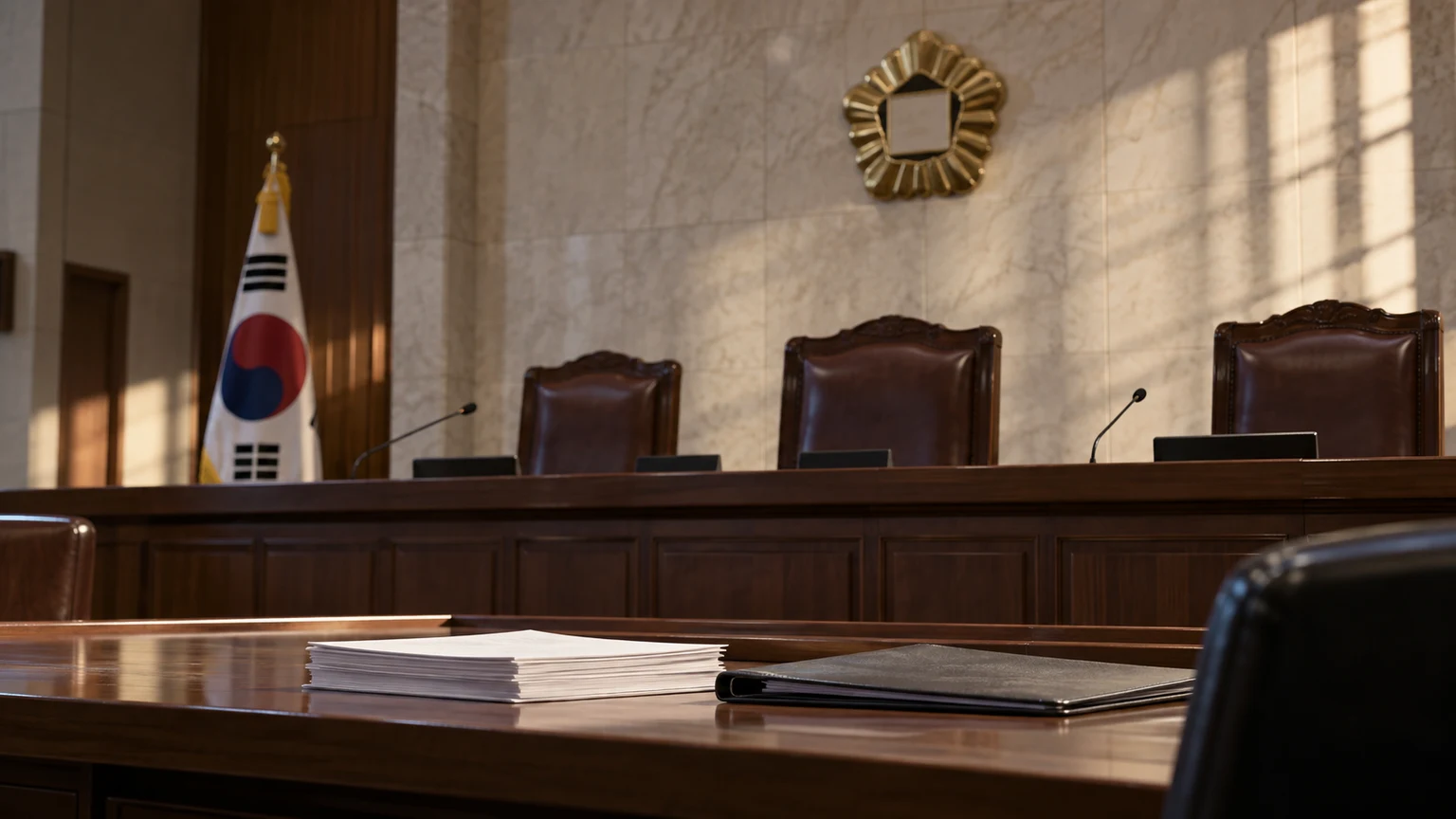
South Korea's presidential office and Supreme Court are in an open constitutional dispute over who should move next in filling a long-vacant seat on the country's highest court. Chief Justice Cho Hee-dae said Tuesday that he would not comply with the presidential office's request to submit another nominee, arguing that the request did not state a specific constitutional basis or sufficient reason. The presidential office answered that Cho's position misunderstood the balance between the chief justice's power to recommend a candidate and the president's power to appoint one.
The confrontation centers on the seat formerly held by Justice Noh Tae-ak. Cho had recommended two candidates in August, including Presiding Judge Son Bong-gi for Noh's seat. The presidential office proceeded with one appointment but asked Cho on August 28 to submit a new recommendation for the other vacancy, citing concerns that included a lack of substantive prior consultation. Cho did not publicly answer for more than three weeks before rejecting the request on September 22.
One vacancy, two constitutional powers
The vacancy has already lasted more than 200 days, according to Korean reporting, and the standoff creates no obvious route to a replacement. Supreme Court vacancies can affect how cases are distributed and how quickly the full court can resolve matters that require participation by the justices. The longer the disagreement continues, the more an abstract argument over appointment powers becomes a question about the court's operating capacity. The length of the vacancy also makes each additional delay more consequential for an institution that normally operates with a fixed complement of justices.
Both sides are grounding their positions in the Constitution, but they emphasize different parts of the appointment process. Cho argues that the chief justice has an independent recommendation power and said the resubmission request lacked the specific legal justification he believed was required. The presidential office says the president's appointment authority would be hollow if the chief justice's recommendation were effectively binding regardless of objections from the appointing authority. Those positions leave the dispute without a simple procedural off-ramp.
The institutional cost of a prolonged standoff
The conflict also arrives at a politically sensitive moment for the judiciary. Ruling-party figures have criticized Cho and called for his resignation, while opposition politicians have defended the court's independence. Those reactions are political claims rather than findings about the Constitution itself. The underlying legal question remains unresolved: how far the president may go in rejecting a recommended candidate, and what obligation, if any, the chief justice has to make a new recommendation.
For readers, the next concrete marker is whether either institution changes its position or seeks a legal mechanism to clarify the boundary between recommendation and appointment. Another candidate could break the deadlock, but Cho's statement indicates he does not currently accept that he is constitutionally required to provide one. If neither side yields, the vacancy and the institutional conflict are likely to continue together.