

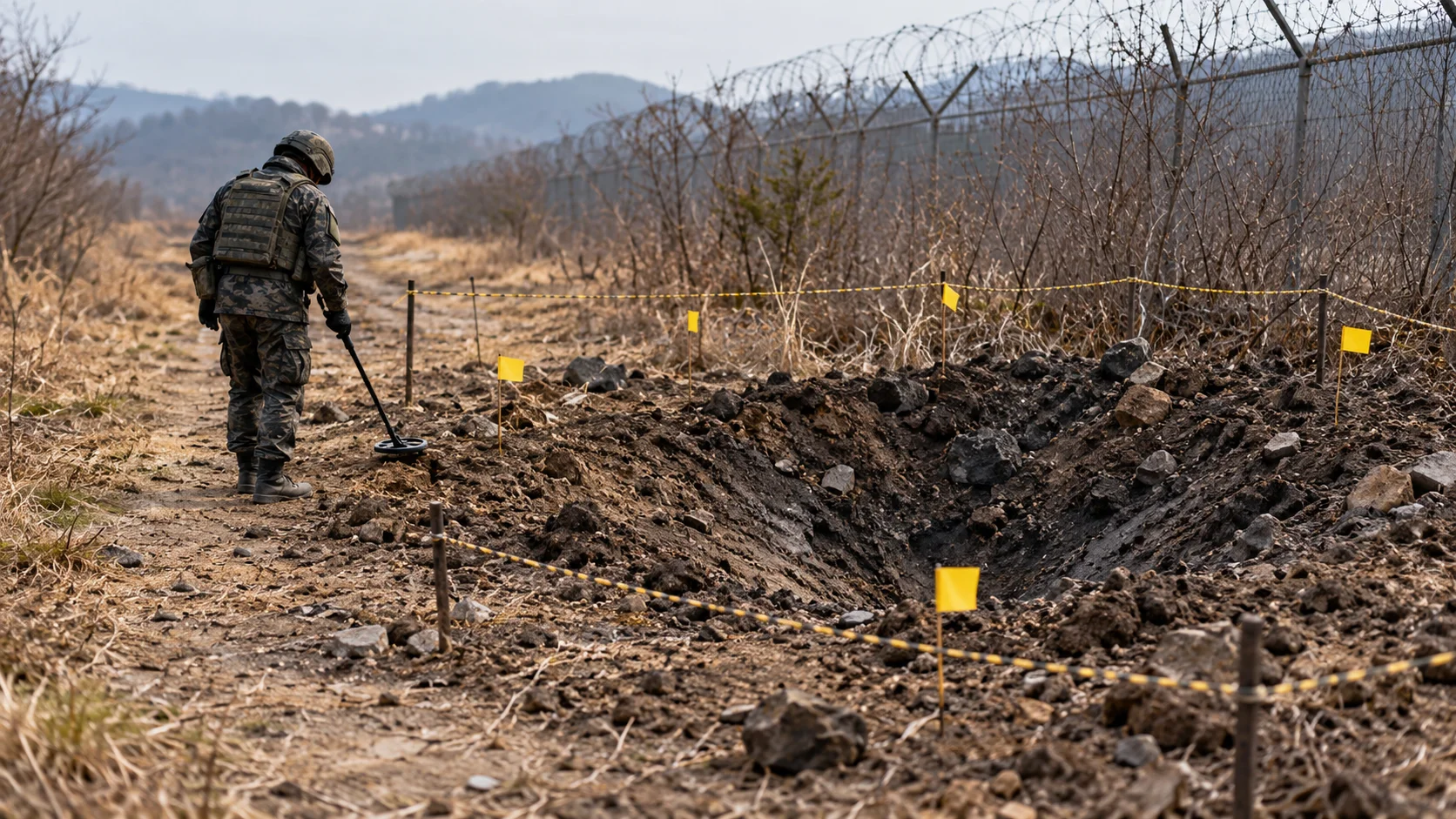
South Korea's military says the September 21 blast inside the western Demilitarized Zone was very likely caused by a North Korean mine, a conclusion that sharply narrows an investigation that began with several possible explanations. A joint field team reached within two meters of the blast point on September 28 and found two crater-like marks that matched soldiers' accounts of two separate explosions. The military also said the site was outside any recorded South Korean minefield.
Soldiers who were at the scene described seeing a brown plastic anti-personnel mine about one meter from the blast point. The type is not used by the South Korean military and has been operated by North Korea for decades, according to the Joint Chiefs of Staff. Another unexploded mine-like object was reportedly seen during the unit's withdrawal. The plastic casing matters because it is harder to detect with standard metal detectors than a mine containing substantial metal components.
Forensic evidence from the scene
Forensic findings reinforced the field evidence. The National Forensic Service detected TNT-related material and brown residue on equipment worn by the injured troops, while recovered fragments did not match South Korean mines. Military officials said the absence of steel fragments was another reason to rule out friendly mines. Investigators are still working to identify the exact model and to determine whether the device was deliberately placed, moved by water or terrain, or had been in the area for a longer period.
The blast occurred as troops were opening a new search route near an area where satellite imagery had shown terrain changes and suspected North Korean mine-laying activity roughly ten meters away. One explosion injured a noncommissioned officer. A second blast followed about a minute later as a battalion commander approached to secure the area. Military accounts and the two craters found during the field inspection line up with that sequence.
The Joint Chiefs have stopped short of final attribution while the investigation continues with the United Nations Command and forensic specialists. But officials now say the probability that a North Korean mine caused the blast is very high. If the final review confirms that finding, the military says South Korea will hold North Korea responsible for injuries suffered by troops operating south of the Military Demarcation Line and will take corresponding measures.
DMZ operating implications
The finding also changes the immediate safety problem for units working in similar terrain. A plastic mine near a route being opened for search operations presents a different detection challenge from familiar South Korean devices, and the investigation is now focused on recovering additional fragments and the remaining suspected mine. The final determination will shape both the military response to this incident and the procedures used for future patrol and search work in the area.