

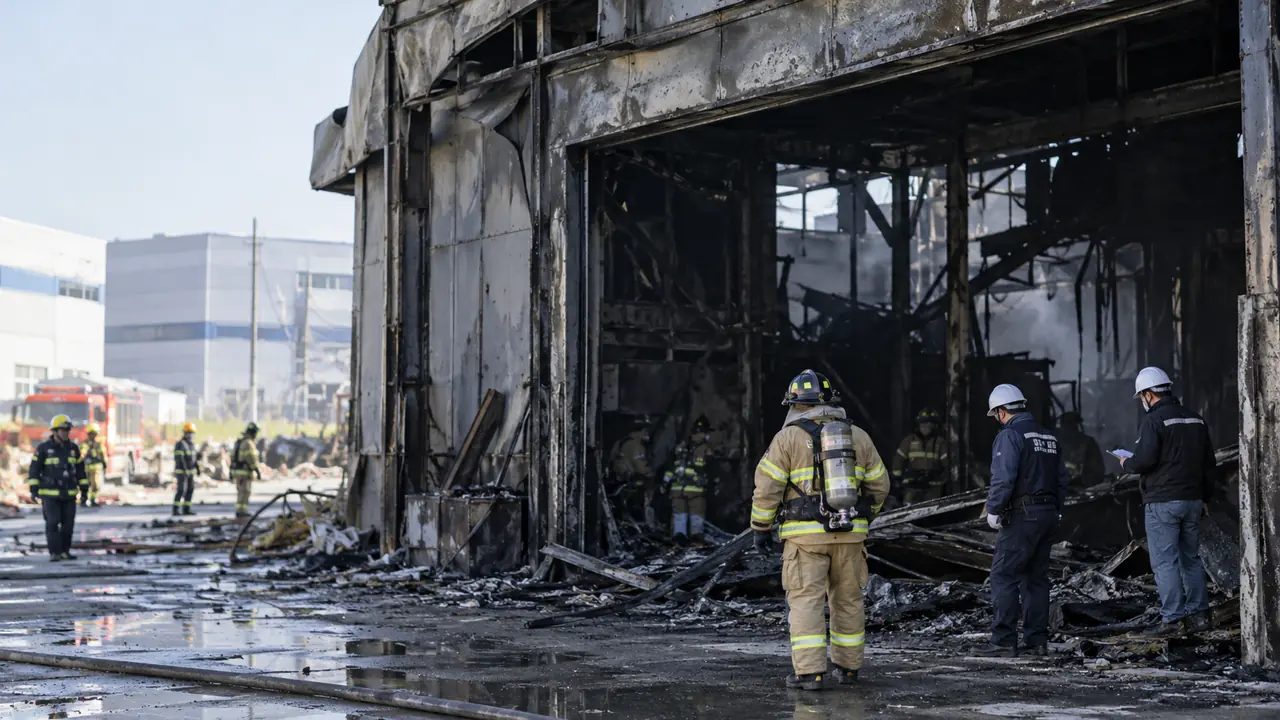
Police have booked the owner of a metal-parts coating factory in Bucheon after a fire killed one firefighter and left seven other people injured. The Gyeonggi Nambu Provincial Police Agency said its dedicated investigation team placed the owner, a man in his 70s, under investigation on allegations of occupational negligence causing injury and accidental fire. Booking the owner opens a formal criminal inquiry but does not establish his guilt or determine the fire's cause.
- Location
- Metal-parts coating factory in Ojeong District, Bucheon
- Fire reported
- About 8:38 a.m. on October 16
- Casualties
- One firefighter killed and seven people injured
- Investigation status
- Factory owner booked; cause and responsibility remain under investigation
The blaze began at about 8:38 a.m. on October 16 on the third floor of the factory in Ojeong District. One firefighter died during the response, while firefighters and factory personnel were among the seven people reported injured. Investigators are examining whether inadequate fire-prevention measures contributed both to the ignition and to the number of casualties.
Thinner and paint shape the fire inquiry
A joint inspection involving 23 officials from the police, fire service, National Forensic Service and Korea Electrical Safety Corporation was conducted on October 17. Investigators found dozens of containers of thinner and hundreds of paint containers at the site. Some thinner containers were open, others showed signs of use, and evidence that thinner had been used was also identified in the metal-cleaning work area.
Police and fire authorities are focusing on the possibility that flammable vapor formed while workers used thinner to clean metal. Investigators are considering whether static electricity or a spark could have ignited that vapor. Reporting on the inquiry also said investigators were examining whether explosion-protected equipment suited to a flammable-vapor environment had been installed, but the ignition source and sequence have not been conclusively established.
The presence of thinner and paint is important because investigators must reconstruct more than the first moment of ignition. They also need to determine how the fire spread, whether open or recently used containers increased the available fuel, and what ventilation or control measures were in place. Each question bears on whether legally required precautions were followed and whether any omission can be connected to the deaths and injuries.
Responsibility depends on forensic and safety findings
Police questioned the owner and four other factory officials as witnesses on October 17 about work procedures and safety management. The inquiry is expected to compare those accounts with physical evidence, inspection findings and applicable safety requirements. Investigators will also decide whether responsibility extends beyond the owner to other people involved in operating or supervising the workplace.
The reported charges center on alleged failures to prevent the fire rather than a final finding about who or what ignited it. Prosecutors would ultimately need evidence linking a specific duty, a breach of that duty and the resulting harm. Forensic findings on residue, electrical sources, work activity and the movement of materials through the third-floor area are therefore likely to shape the direction of the case.
Scrutiny also extends to the emergency response because a firefighter died during the operation. A firefighters' union has called for an examination of the decision to send personnel into the building and the adequacy of command at the scene. That issue is distinct from the criminal investigation into factory safety, although both inquiries arise from the same fatal fire. Authorities have not yet announced a final cause, a complete allocation of responsibility or any prosecution decision.