

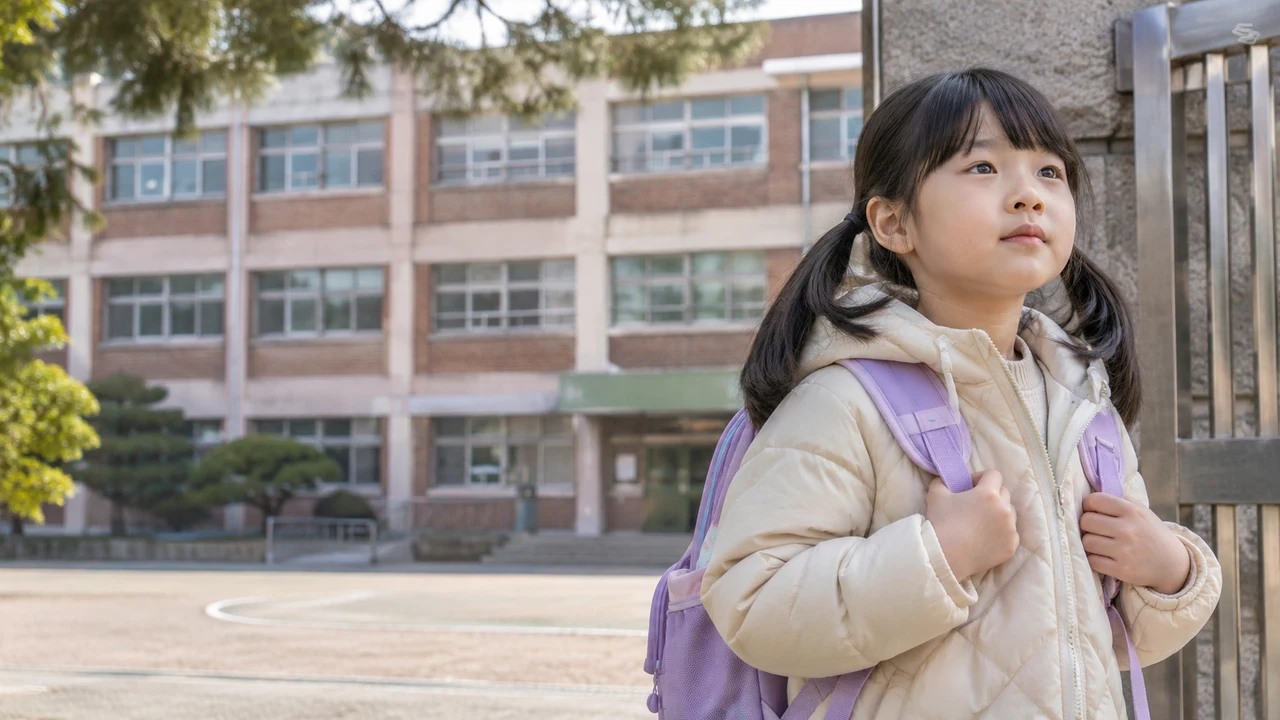
South Korea’s elementary school intake is expected to fall below 300,000 in 2027 for the first time on record, bringing the country’s long-running decline in births directly into the first-grade classroom. Reports drawing on the Korean Statistical Information Service and Korean Educational Development Institute data say the number of children receiving elementary school admission notices in December is likely to remain in the 200,000s and set a record low.
The projection is anchored in the size of the 2020 birth cohort. South Korea recorded 272,337 births that year, down 10 percent from 302,676 in 2019. Those children form the main age group due to start elementary school next year, although the birth total and the eventual number of enrolled first-graders are not identical measures.
A historic threshold reached within three years
The expected intake marks a rapid crossing of demographic thresholds. Elementary enrollment entered the 300,000 range in 2024, and the projected 2027 intake would take it into the 200,000 range only three years later. The reports describe the decline below 300,000 as unprecedented.
The longer comparison is even sharper. The number of elementary entrants reached about 1.05 million in 1968, the historic peak cited in the reports. A cohort of roughly 272,000 children would be close to one quarter of that level 59 years later, illustrating how extensively the population base of the school system has contracted.
The available figures do not establish a final nationwide enrollment count for 2027. Births provide the central basis for the forecast, while admission notices and subsequent education statistics will determine the actual number entering school. The evidence also does not quantify how enrollment losses will be distributed among individual regions, districts or schools.
School consolidation is already under way
School consolidation has already begun as the school-age population shrinks. From 2021 through 2025, 153 schools closed through consolidation, including 120 elementary schools. Among 32 areas designated as population-decline regions, 22 were pursuing consolidation of small schools, according to the reports.
The pressure is not confined to rural communities or smaller regional cities. Seoul closed Yeomgang Elementary School in 2020 and Hwayang Elementary School in 2023, while Deungmyeong Elementary School is scheduled to close in 2028. These cases show that falling student numbers are also reshaping the school network in the capital.
A smaller national cohort does not translate mechanically into the same percentage decline at every school. The supplied evidence gives nationwide birth and enrollment indicators alongside selected closure figures, but it does not provide school-level intake projections or a common denominator for comparing all affected areas. The national trend is therefore clear, while its local effects must be assessed through district enrollment and consolidation data.
Birth numbers have risen modestly over the past two years, according to the reports, but the increase has not been large enough to reverse the near-term enrollment pattern. Elementary intake is consequently expected to remain in the 200,000 range for a considerable period. December’s admission notices and the final 2027 education statistics will provide the next firm measures of how closely actual first-grade enrollment follows the 2020 birth cohort.