

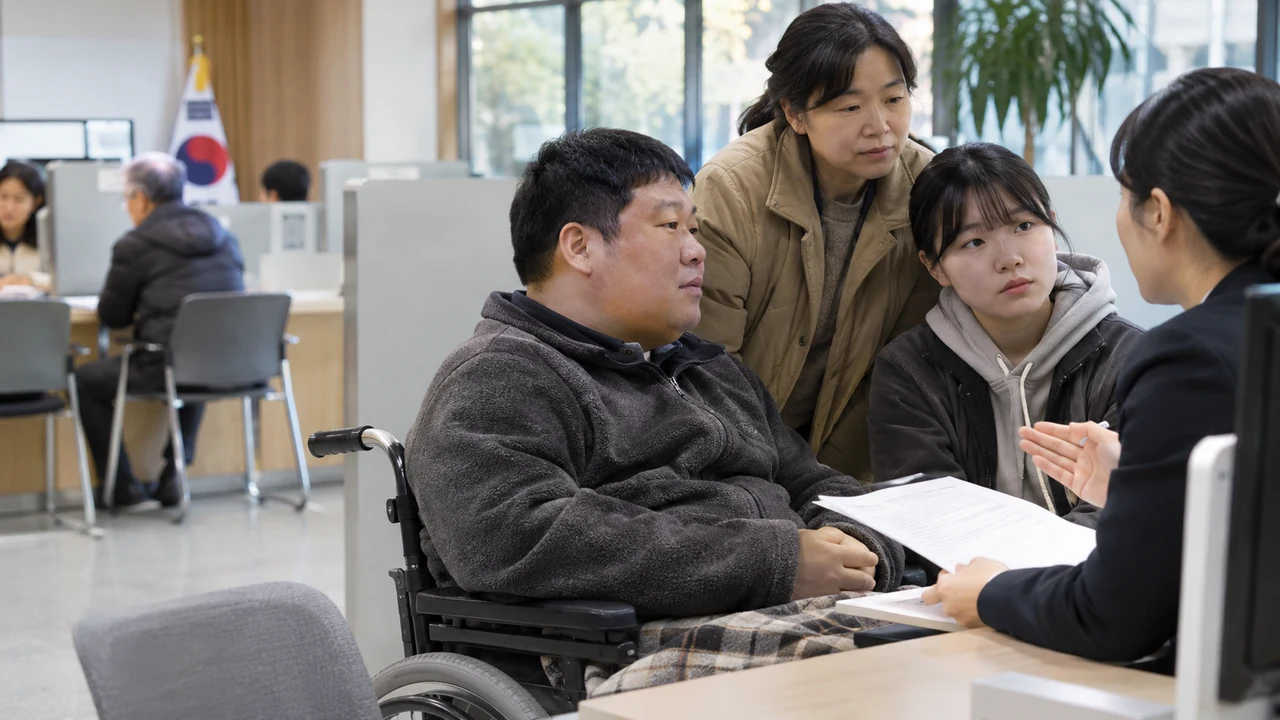
South Korea will gradually widen access to its basic livelihood benefit while creating a same-day advance for households facing an abrupt financial crisis. Under the fourth comprehensive basic livelihood security plan approved by the Central Livelihood Security Committee, the income-recognition threshold for the benefit will rise from 32 percent of median income to 35 percent by 2030.
The threshold will remain at 32 percent through 2027, then increase by one percentage point each year from 2028. It will reach 33 percent in 2028, 34 percent in 2029 and 35 percent in 2030. The higher cutoff will allow some households currently just above the eligibility line to qualify, while existing recipients with the same recognized income may receive larger payments.
A higher threshold expands both access and payments
For 2027, the maximum monthly livelihood benefit is set at 875,533 won for a one-person household and 2,217,563 won for a four-person household. The benefit paid to an eligible household reflects the gap between the applicable selection threshold and its recognized income. One reported example showed that a one-person household with recognized monthly income of 900,000 won would exceed the 2027 threshold, but could qualify for about 58,000 won if 35 percent were applied to the current median-income benchmark.
The government expects the number of livelihood benefit recipients to rise from 1.94 million in June to 2.21 million in 2029, an increase of 270,000 people. That projection reflects the planned expansion of the threshold, although the supplied material does not provide a separate annual breakdown for newly eligible households.
A second change concerns the family-support obligation test, which can consider the income and assets of parents or children living separately. From the second half of 2027, the government plans to abolish that test for both livelihood and medical benefits when a household includes a person with a severe disability. About 20,000 households are expected to gain additional support. The government will also consider phasing out the test for households with people aged 75 or older by 2030.
Family-support rules and emergency access will change
Other eligibility rules are set for revision. The government plans to simplify the treatment of automobiles by placing greater weight on vehicle value instead of the current combination of engine size and vehicle age, while lowering the income-conversion rate applied to vehicle assets. The housing benefit threshold is also scheduled to expand gradually from 48 percent to 50 percent of median income.
The plan includes proposals directed at younger recipients. Authorities will examine paying an individual share of the livelihood benefit directly to recipients aged 19 to 29 who live apart from their household. A separate transition-to-independence exception for people aged 34 or younger is also under consideration, but the supplied evidence does not specify eligibility details or an implementation date.
- 2027 maximum for one-person household
- 875,533 won per month
- Same-day crisis advance
- 300,000 won, deducted from later emergency support
- Threshold increase begins
- One percentage point annually from 2028
Households hit by business closure, illness, job loss or another sudden disruption will be able to seek a 300,000 won same-day advance through local township, town or neighborhood offices. A public official must first confirm that the situation is urgent. The advance will then be deducted from the emergency welfare livelihood payment later approved for the household, so it is an early portion of that support rather than an additional benefit.
Implementation will unfold on different schedules. The 2027 benefit levels are already specified, the severe-disability family-support test is due to end in the second half of that year, and the general livelihood threshold increases begin in 2028. Further administrative guidance will need to clarify the revised vehicle assessment, youth provisions, local handling of same-day advances and the proposed timetable for older households.