

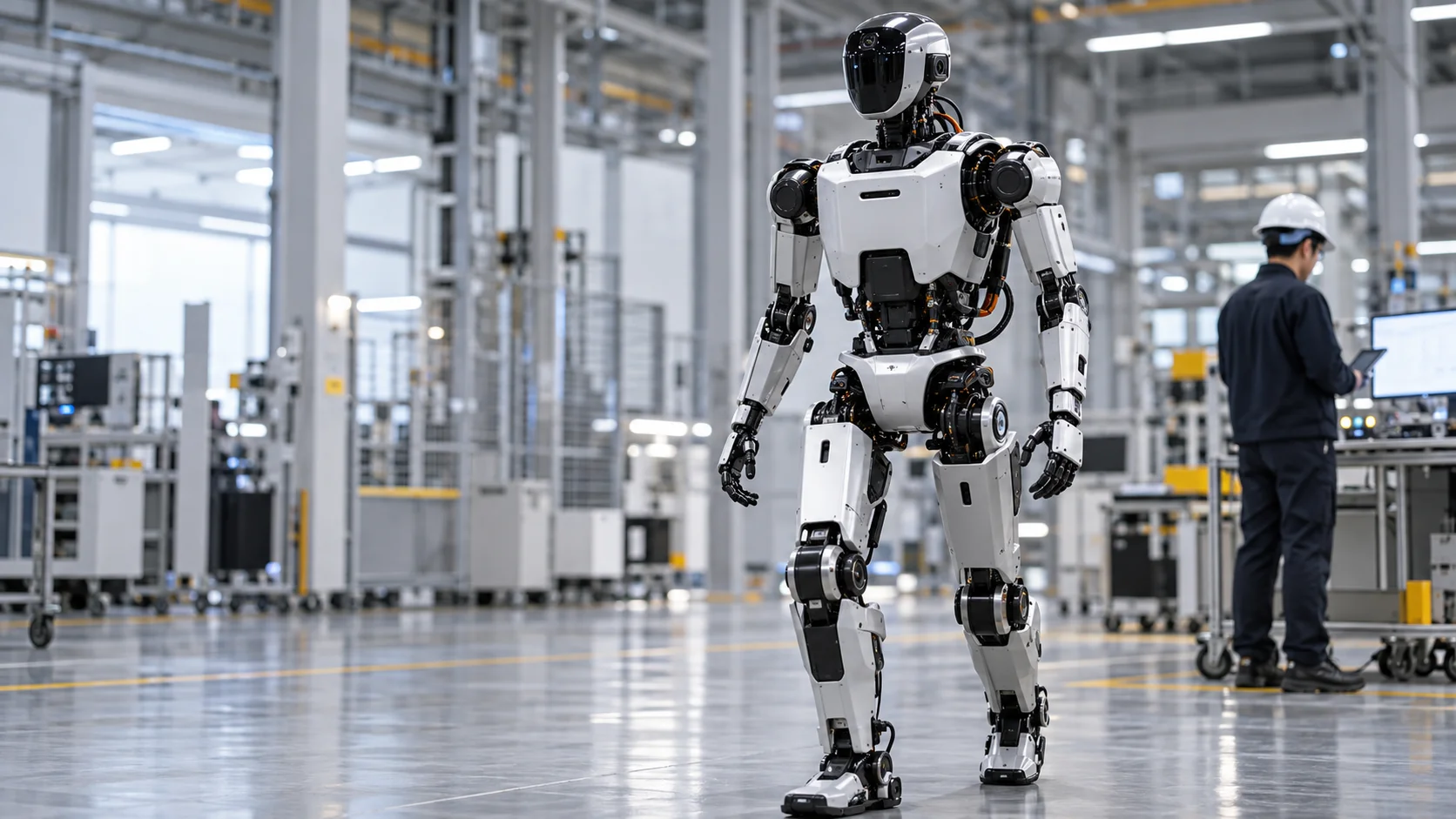
South Korea has designated Daegu and North Gyeongsang Province as the country's first national strategic high-tech industrial complex focused on robots, giving the region a formal role in the government's push to build a domestic humanoid industry. The designation was approved on September 30 by the National Strategic High-Tech Industries Committee. The government's plan is to connect research and development, core components, finished humanoid robots and field testing inside one regional production system rather than support those activities as separate projects.
The decision combines Daegu with Gumi and Pohang in North Gyeongsang after the areas had applied separately. The government cited the value of linking their industrial capabilities. In Gumi, national industrial complexes are included in the designated zone, and the city is positioned to produce key parts such as actuators, sensors, controllers and batteries as well as finished robots. The structure gives the region a clearer division of industrial roles while keeping those roles inside one national policy framework.
A regional chain for humanoid production
The designation also comes with a large planned investment figure. Maeil Shinmun reported that private investment planned for the Daegu-Gyeongbuk robot complex totals 5.3839 trillion won through 2032. Across the three newly designated complexes in robots, defense and secondary batteries, planned private investment reaches 12.9877 trillion won through 2042. Those numbers describe investment plans attached to the designations. They should not be read as money already spent or as a guarantee that every planned project will be completed.
For Gumi, the policy adds a new layer to an economy already built around large-scale manufacturing. The city's role in the robot complex is centered on production and supply-chain capacity, while the wider Daegu-Gyeongbuk designation is intended to connect development, components, finished systems and real-world demonstration. Maeil Shinmun also linked the region's industrial outlook to previously announced Samsung Electronics and Samsung SDS investment plans totaling 19 trillion won in Gumi, although those plans are separate from the robot-complex investment figure.
The significance of the designation is therefore organizational as much as financial. It gives the government and local industry a single map for building a humanoid supply chain across several cities, rather than relying on isolated facilities or one-off projects. For companies, the practical value will depend on whether suppliers, manufacturers and testing programs begin to cluster around the designated zone. For the region, the policy creates a platform for competing for new facilities and production work, but the label itself does not guarantee commercial scale.
From designation to industrial output
Execution will be visible in concrete industrial activity. Factory openings, supplier commitments, component production and field deployments will show whether the new cluster is moving from designation to sustained output. The clearest measure will be whether the region can turn its planned investment and existing manufacturing base into a continuous chain from parts to finished humanoid systems. If that happens, Daegu-Gyeongbuk will have established a distinct national role in one of South Korea's most heavily promoted emerging industries.