

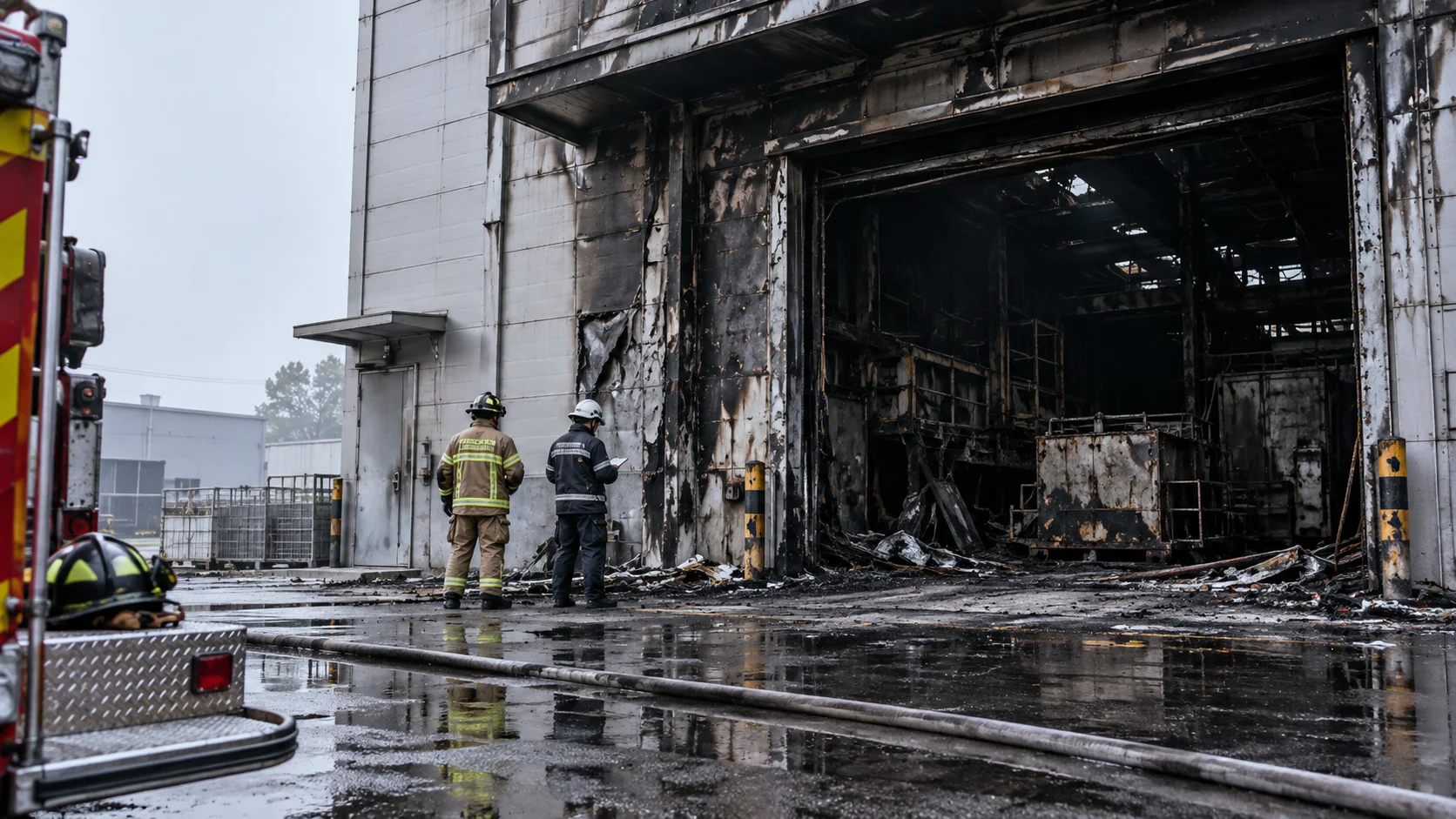
The most consequential stories in South Korea this week concerned promises of protection that were tested in public. A woman was killed after reports of stalking; a man subject to electronic monitoring was accused of injuring eight people in an Incheon shopping complex. A firefighter died after a factory blaze in Bucheon, and reports about industrial hazards and criminal sentences reopened the question of how effectively workplace rules prevent deaths.
Outside homes and workplaces, other safeguards came under strain. The Kospi suffered a trading halt and its sharpest daily shock of the period before recovering a fraction of the loss. Financial authorities widened their accounting of data breaches. North Korea displayed more missile capabilities while a South Korean reconnaissance satellite was reported to have been unavailable for months. These were distinct events with different causes, but each provided concrete information about a system on which people rely and the limits of its performance.
Stalking deaths and the Incheon attack put protection orders under scrutiny
On October 11, a man suspected of domestic violence allegedly killed his mother-in-law in Seoul's Songpa District and abducted his wife. Police found the wife alive and arrested the suspect in Yangyang, Gangwon Province, that afternoon. The case drew attention to an approach restriction that had expired just 11 days earlier. Police had sought another protective measure, according to reports, but the attack took place before the danger had been contained.
Another woman, aged 57, was found dead in a car in Asan after two previous stalking-related reports involving a man with whom she had been in a relationship. Police are examining what happened after she entered the vehicle and how earlier complaints were handled. An October 18 editorial in Dong-A Ilbo cited four killings connected to dating or domestic violence over October 11 to 13 and called for stronger measures to keep alleged perpetrators away from people at risk. Those cases need their own investigations; their proximity in time is a reason for scrutiny, not proof that the same procedural failure occurred in every case.
The Incheon attack added a different question. On October 13, eight people were injured at a commercial complex, including a young woman who required emergency medical care. The alleged assailant was wearing an electronic ankle monitor. President Lee ordered a review of the supervision system, and the Justice Ministry apologized and promised an investigation. The suspect was subsequently detained; police also authorized release of his identity after a statutory review. Neither detention nor identity disclosure answers whether supervision should have detected an imminent attack.
The connection across the week lies in the questions for public authorities. How do repeat reports change an assessment of immediate danger? Who acts when a protection order expires? What can electronic monitoring realistically detect, and when must it prompt an intervention? The answers require case files, timelines and independent review of operational decisions. Tougher statements alone would tell vulnerable people little about whether help will arrive in time.
Bucheon's factory fire gave industrial-safety enforcement a human cost
Firefighter Kim Jin-seok died after responding to a fire at a metal-parts factory in Bucheon on October 16. The blaze injured other responders and workers. President Lee visited the funeral hall the following day, paid tribute and presented a posthumous honor. The continuing investigation has focused on flammable thinner vapor, a possible spark and the adequacy of explosion-protection equipment. These are reported investigative hypotheses and safety questions, not final findings about ignition or legal responsibility.
Earlier in the week, President Lee had ordered a probe of a battery plant after allegations that workers received injections presented as vitamins while lead exposure exceeded safety standards. The allegation requires investigation, particularly over who knew of hazardous exposure and what medical treatment or preventive measures were actually provided. The factory fire and injection allegations involve different companies and hazards; both point toward the importance of reliable inspection records, protective equipment and a clear division of responsibility between employers and regulators.
The week's clearest national enforcement measure came from the Labor Ministry. It disclosed 37 workplaces where sentences connected to serious industrial accidents had become final during the first half of the year. The cases involved 38 deaths and four injuries. Of 39 responsible managers, one received an immediate prison sentence; most received suspended terms. These figures describe finalized cases, rather than all workplace accidents or a complete measure of deterrence.
Accountability has several stages: a credible investigation, a lawful judgment, remedial action at the affected site and preventive changes at similar workplaces. The Bucheon inquiry will be judged on whether it establishes the dangerous conditions firefighters encountered. The published conviction list should also be used to assess which safety breaches continued to occur after the serious-accident law took effect.
The Kospi's slide tested confidence even as household borrowing slowed
South Korean equities had a punishing week. On October 15, the Kospi fell 7.57 percent to 5,554.22, and circuit breakers temporarily halted trading in both the main and secondary markets after intraday declines reached the relevant thresholds. Korean reporting traced a seven-session decline of more than 20 percent from an earlier high, alongside foreign selling and anxiety about US interest rates, energy costs and the profitability of enormous AI investments. These are competing market explanations, not a single proven cause of the selloff.
A raw-source follow-up on October 16 recorded a 2.05 percent Kospi rebound to 5,668.05. The gain matters because a Weekly record should preserve the week's final change, not stop at the moment of maximum fear. It recovered only a modest portion of the earlier fall. Regulators held emergency discussions about market volatility and promised closer scrutiny of manipulation and disorderly trading. Separate reporting noted continued leveraged purchases and forced selling, exposing a particularly painful risk for investors who must repay loans even when share prices fall.
Credit data supplied a different perspective. Household lending fell by a provisional 2.2 trillion won in September, its first monthly decline since December 2025. But mortgage lending still rose by 3.3 trillion won while other types of household borrowing fell by 5.5 trillion won. A falling headline credit total, therefore, does not demonstrate that home-financing pressure has disappeared.
Longer-term industry plans continued alongside the correction. Hyundai Motor Group announced a planned $15.5 billion investment in India through 2032, with manufacturing capacity, research and suppliers central to the strategy. That is a multi-year commitment, not spending already completed. The week's contrast was between investors rapidly repricing risk and companies making decisions that may take years to show results.
North Korean missile displays met a gap in South Korea's surveillance network
North Korea fired several ballistic missiles on October 12 from the Pyongyang area toward the East Sea, prompting an emergency national-security review in Seoul. South Korean military assessments indicated that at least one type travelled more than 900 kilometres. The launch followed Seoul's disclosure of a hypersonic weapons test, but proximity in time alone cannot prove that the North's choice of weapons was a direct response.
On October 15, South Korean reports described the North's assertion that it had launched two types of strategic cruise missiles from a submarine on October 14. Published imagery suggested an undersea platform, possibly a vessel unveiled in 2023, but the vessel's identity and any claimed nuclear capability require independent corroboration. The important operational difference is the potential ability to launch from a moving location rather than a familiar land-based site.
South Korea's own reconnaissance system faced questions after MBC reported that one of its five military spy satellites had been offline since May following failures of attitude-control equipment. The military said the other satellites were functioning and critical surveillance had not been disrupted. Even accepting that assurance, redundancy has less room to absorb the next fault when one platform cannot operate as intended.
These stories should be read together as a test of verification. Weapons can be displayed and impressive claims made within hours; maintaining a dependable warning and monitoring network takes years of operation. Whether the submarine deployment is repeatable, and whether the satellite can be restored, remain more meaningful questions than the imagery alone can answer.
Financial breaches widened as public data systems exposed separate weaknesses
Korean financial authorities confirmed intrusion cases at 16 financial firms across banking, savings, consumer finance, payments and virtual assets. About 100,000 records of personal information had been reported leaked by October 14. The count refers to records, not necessarily 100,000 unique people. The Financial Services Commission's wider security checklist found deficiencies at 130 of 555 institutions reviewed.
Regulators said they were examining whether related methods or AI-assisted tools were involved. There is an important distinction between suspected technological involvement and an established account of how the intrusions happened. The confirmed scope already creates an urgent problem: exposed identification and contact data can make later phishing messages more convincing even without direct access to a customer's bank balance.
A different lapse came from the drug regulator. An opposition lawmaker said 2,672 restricted clinical-trial files could be retrieved without logging in, after which the regulator blocked the access route and began investigating. The claim concerns an access-control weakness rather than the same financial hacking operation. Taken with the financial breach disclosures, it highlights why simply collecting sensitive records creates obligations to restrict access and discover failures quickly.
At the same time, Kakao introduced Kanana Space, a proposed assistant tied to KakaoTalk, with a limited trial expected in December. Its promise is convenience in search, planning and eventually transactions. If such assistants begin acting on private histories or handling purchases, permissions, user confirmation and limits on access will matter as much as the underlying AI model. The week's breaches demonstrate why those questions should be answered before mass adoption, rather than afterward.
Police reshuffles and judicial confrontation raised the stakes for accountability
South Korea reassigned 118 of 242 police station chiefs in an October 13 reshuffle, applying a rule intended to keep senior officers from overseeing policing in their own home regions. The stated goal is to reduce risks from local relationships. Its practical trade-off is that incoming chiefs must learn their new districts, existing investigations and emergency networks quickly.
Parliament separately questioned how police handled a contested sexual-assault investigation that prosecutors subsequently pursued. The acting police chief promised changes. Both the personnel shuffle and those hearings concern accountability, but a transfer policy cannot substitute for good evidence handling, timely victim protection or documented supervisory decisions. The violence cases earlier in this Weekly show how consequential those operational details can be.
Confrontation between political leaders and the judiciary intensified. Democratic Party leader Kim Min-seok said the party was considering all responses concerning Chief Justice Cho Hee-dae, including the possibility of impeachment. No formal motion or vote was announced. Lawmakers also disputed the constitutional basis for suspending criminal proceedings involving President Lee while he holds office.
The rival interpretations remain politically contested: supporters of stronger legislative scrutiny argue that senior officials and judicial institutions must be accountable, while critics warn that impeachment threats and courtroom pressure can compromise judicial independence. The reliable distinction for a reader is between an announced political position, a proposal that could be put to a vote, and an actual court ruling. This week moved the argument forward but did not settle those constitutional issues.
Public care faced a staffing problem that budgets alone cannot cure
Government data showed 24 of 63 public hospitals with specialized dementia wards had no neurologist, neurosurgeon or psychiatrist in the relevant staffing categories, a gap of 38.1 percent. That does not mean those hospitals had no doctors, but it does mean the specialist expertise expected for complex dementia care was missing from many designated wards. At a county hospital in North Chungcheong Province, the account also identified unfilled occupational therapy and clinical psychology roles.
Gyeonggi Province's assembly, meanwhile, approved a revised budget of 42.2 trillion won to keep welfare, health and education programs funded while local tax revenue faced pressure. The measure establishes financial provision; it does not by itself confirm that every service has enough qualified people to deliver care. Elsewhere, reporting warned that nearly half of child-headed households in an LH rental-housing program had at least three months of unpaid rent, leaving their renewal status at risk.
Across these separate services, access depends on more than the announcement of a benefit. Residents need staffed hospitals, affordable and stable housing, and administrative systems able to identify people likely to lose support. The coming practical test is whether approved funds and existing programs prevent gaps at the point of use, especially outside Seoul.
Worth remembering
A Daegu ceiling collapse injured 38 people
Investigators examined collapsed finishing materials, supports and camera footage after a commercial event for older shoppers. The cause remains a matter for forensic findings.
Seoul endured record mid-October heat
Temperatures reached 29.6°C on October 12 and a reported 30.1°C on October 13. The unusual readings are individual weather records; claims about their long-term causes require separate climate analysis.
Free flu and COVID-19 vaccination expanded for people 65 and older
Eligibility and timing matter to older residents planning autumn protection. Check local health-service details before visiting a clinic.
Kim Do-young powered a KIA playoff win
The baseball star hit two home runs and drove in four runs in a 5-1 win over LG. It was an important sporting result, though a single game cannot decide the entire series.